
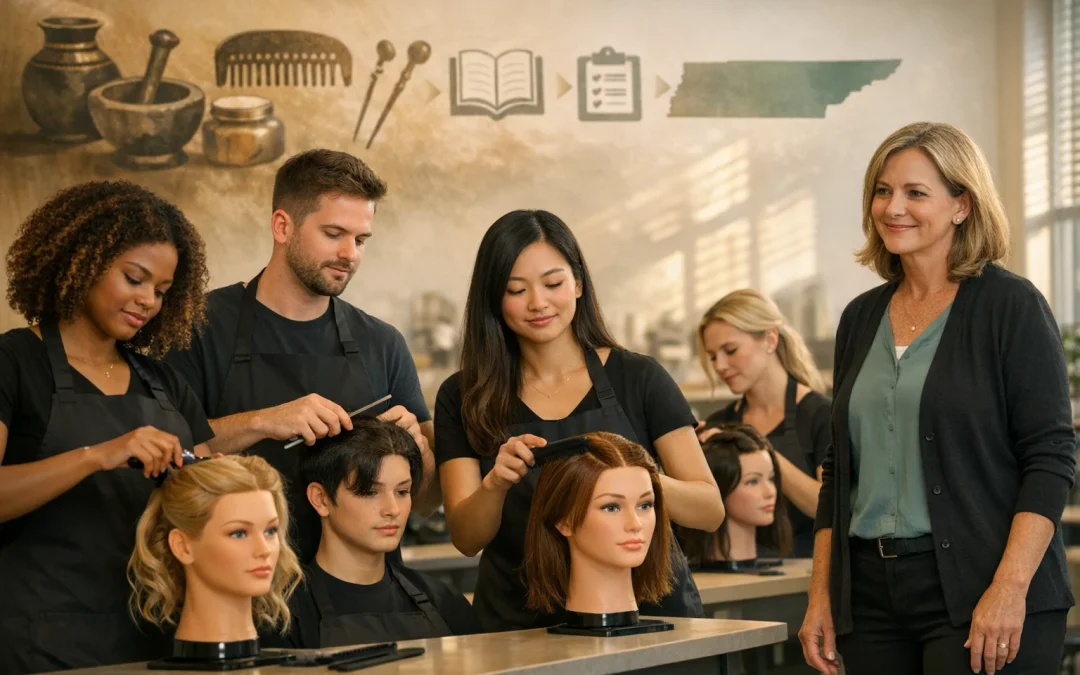
The Roots of the Modern Cosmetology License (And How to Earn Yours in Tennessee)
The word cosmetology comes from the ancient Greek word kosmetikos, meaning skilled in adornment. That etymology is not a coincidence. It reflects the fact that beauty work has always been understood as a craft requiring real knowledge, not just instinct or improvisation. Civilizations separated by thousands of years and thousands of miles reached the same conclusion independently: the people who cared for others’ appearance needed to know what they were doing.
A cosmetology license in Tennessee is the modern expression of that ancient understanding. The state requires 1,500 hours of training and two licensing exams before anyone can practice professionally. That credential is rooted in a much older story than most people realize.
From Ancient Egypt to Medieval Guilds: Beauty Work Before There Were Beauty Schools
<cite index=”41-1″>The start of cosmetology can be traced to ancient Egypt, where practitioners used various organic and mineral materials to create cosmetics as far back as 4000 BCE.</cite> Kohl lined the eyes. Henna colored hair and fingernails. Scented oils were worked into skin to protect against the desert climate. These were not casual habits. They were part of religious ceremony, daily ritual, and social hierarchy. The people who applied them skillfully occupied recognized roles in Egyptian society.
Greece and Rome expanded beauty practice into public life. Greek athletes oiled their bodies before competition. Roman bathhouses offered exfoliation, massage, and fragrant oils alongside heated pools and cold plunges. The Latin word cosmetae referred to skilled personal attendants whose entire professional role was managing appearance. Beauty work was organized and respected because it required real knowledge to do well and real consequences when it went wrong.
Medieval Europe added formal structure. <cite index=”38-1″>Cosmetology licensing is historically rooted in medieval guilds, which were refined during the Progressive Era. These regulations were primarily established to mitigate the transmission of infectious diseases and to ensure that practitioners possessed a minimum level of technical competency.</cite> Guild membership meant meeting standards, completing an apprenticeship, and demonstrating competency before serving the public. The guilds existed not just for professional prestige. They existed because unsanitary tools and untrained hands spread disease.
<cite index=”36-1″>The word cosmetology became more common in the early 1900s when organized schools and licensing standards started to take shape. This period laid the foundation for today’s structured cosmetology programs.</cite> The same argument that justified medieval guilds crossed the Atlantic and became state licensing boards. Formal training replaced informal apprenticeships. Licensing exams replaced guild assessments. The goal remained identical: protect the public from practitioners who did not know what they were doing.
Why Licensing Exists: The Public Health Argument That Has Not Changed
The 1,500-hour requirement for a cosmetology license in Tennessee exists because beauty work involves real risk when performed without proper training. Chemical services can damage hair and skin if applied incorrectly. Unsanitized tools transmit infection. A practitioner who does not understand contraindications can harm a client with an underlying condition.
Tennessee’s licensing exams test exactly these things. The written theory exam covers sanitation, infection control, chemical safety, anatomy and physiology, and state law. The practical exam tests whether a student can perform services safely and correctly under timed conditions. These standards reflect over a century of public health reasoning built on a foundation that goes back much further.
The medieval guilds would recognize the logic immediately.
How to Get Your Cosmetology License in Tennessee
The path to a cosmetology license in Tennessee has four clear steps.
Step one: Complete 1,500 hours at a Tennessee Board-approved school. The curriculum covers haircutting and styling, hair color, chemical texture services, basic skin care, nail care, makeup application, sanitation and infection control, client consultation, and state board preparation throughout. Tennessee also requires completion of domestic violence awareness training as part of the licensing process.
Step two: Pass the PSI written theory exam. This covers cosmetology knowledge, chemistry, sanitation, safety, anatomy, and Tennessee state regulations. Quality programs build exam preparation into the curriculum from the beginning so the content feels like review rather than new material by exam day.
Step three: Pass the PSI practical skills exam. You perform specific services on a mannequin and sometimes a live model under timed conditions. Station setup, correct sanitation steps, and technical execution all factor into the score. Consistent supervised practice during training is the most reliable preparation.
Step four: Apply for your Tennessee cosmetology license. After passing both exams, you submit your license application. The credential is yours permanently. It travels with you across employers, cities, and career paths.
The Cosmetology program at the Genesis Career Colleges Cookeville campus aligns its curriculum to Tennessee state board requirements from day one. Students practice on real clients in a supervised student salon setting rather than only on mannequins, which builds the kind of readiness the practical exam actually requires.
What a Cosmetology License in Tennessee Opens Up
A cosmetology license in Tennessee is a portable professional credential that belongs to the graduate, not the employer. It opens a range of professional settings: independent salons, resort and hotel spas, bridal and event styling, freelance work, and eventually education or salon ownership for graduates who want to build something of their own.
According to the U.S. Bureau of Labor Statistics, employment for barbers, hairstylists, and cosmetologists is projected to grow faster than average through 2034. Tennessee specifically shows strong momentum, with some projections pointing to cosmetology job growth of around 30 percent by 2032. After graduation, the Genesis Career Colleges career services team supports students with resume help, job search connections, and employer contacts in the Cookeville area and beyond.
The craft has a 6,000-year history. The license has been a requirement for over a century. Both reflect the same fundamental understanding: working on people requires knowledge, and knowledge requires training.
Ready to Start Your Cosmetology License in Tennessee?
Financial aid is available for eligible students at Genesis Career Colleges. You can begin the federal aid process at studentaid.gov before your first admissions conversation.
- Learn about the Cosmetology program including curriculum, schedule options, and upcoming start dates
- Schedule a campus tour to see the student salon and meet the instructors in person
- Apply now when you are ready to begin
Cookeville campus: 880-A East 10th St., Cookeville, TN 38501 | (931) 526-8735
Genesis Career Colleges | Cookeville, TN Campus Authorized for operation as a postsecondary educational institution by the Tennessee Higher Education Commission.